
Architecture of a convective dryer
Drying processes are ubiquitous in industry. A dazzling variety of products, from fish food, through packaging, to bricks and cars, involves a drying step in their manufacturing; this step is often the most energy-intensive part of the production process.
Most dryers (85% according to some sources [1]) are of the convective type – they simply blow hot air over the product to evaporate the water contained in it. There are many types of convective dryers (spray, drum, conveyor, tray etc.). Schematically they all look like this:
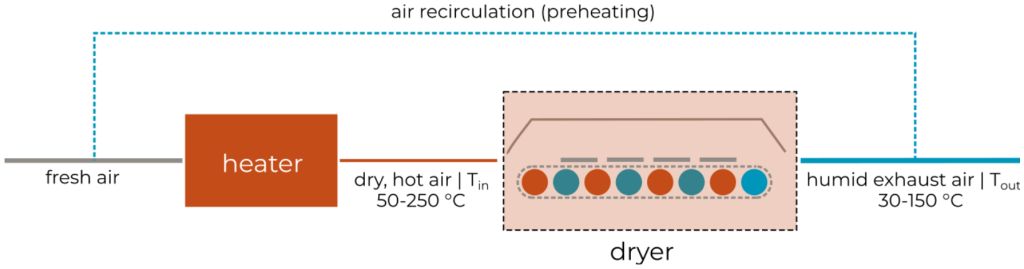
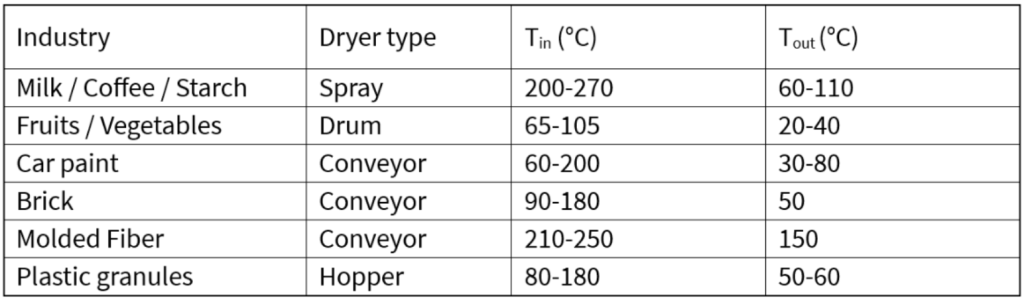
The drying air temperature is usually in the range 50-250°C. The table above lists a selection of processes and the typical drying temperatures.
Air is usually drawn from ambient. It’s heated by burning liquid, gas, or solid fuel, which emits massive amounts of CO₂ emissions. We can bring those emissions down to zero by electrifying the drying process and using green electricity to run it. The most energy-efficient way to electrify a dryer is by using a heat pump.
Heat pumps in dryers – integration concept
We explained how a heat pump works in our previous deep dive article. If you haven’t read it already – check it out! A quick reminder: heat pumps use electricity to move heat from a low temperature source to a high temperature sink, or the other way round.
When directly generating heat in a gas burner, or in an electric heater, we cannot generate more than one unit of heat for one unit of input energy. In a heat pump, however, a single unit of electricity can move 2-5 units of heat. The ratio between electrical energy input and thermal energy output is called the Coefficient of Performance (COP).
Heat pumps are already prevalent in many applications, such as refrigeration (almost every fridge has a heat pump!), or in heating our homes. However, convective dryers present unique challenges for heat pump technology, which historically have made it difficult to decarbonise drying processes. To understand why, let’s examine what a simple heat pump integration in a dryer could look like, and what temperatures the heat pump would need to operate at.
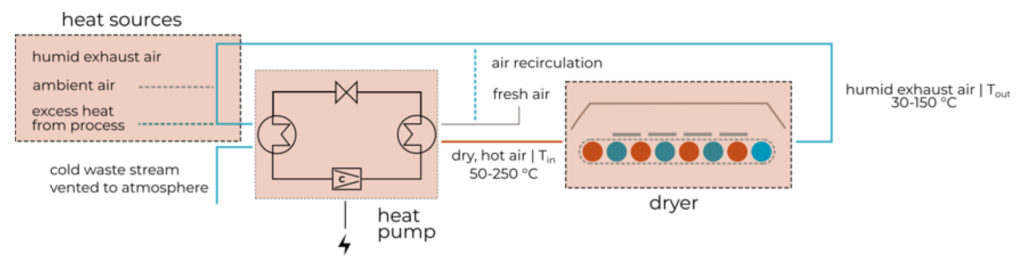
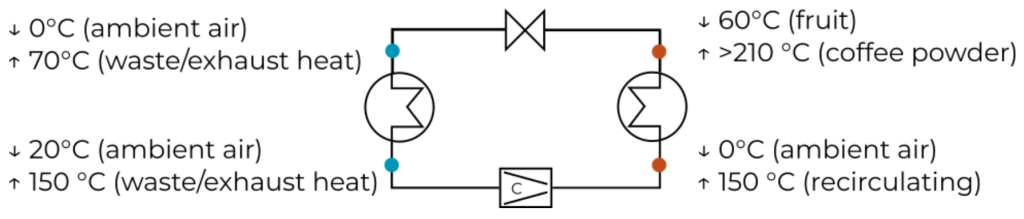
The source for our heat pump can be ambient air, moist air from the outlet of the dryer, waste heat from another part of the process, or a mixture of the above. The heat pump could heat outside air, or recirculate outlet air from the dryer. Implementation details will be highly dependent on the process and the facility. But this high-level sketch is sufficient to illustrate the three main challenges present whenever a heat pump is integrated into any convective drying process:
- The difference between sink and source temperatures in the cycle can be on the order of 100-200°C – there is a high temperature lift
- The maximum temperatures needed are often high, over 200°C
- The medium being heated (air) changes its temperature significantly – there is a high temperature glide
These challenges push the boundaries of conventional heat pump technology and compressor design. Let’s go through them one by one and explain why.
Heat pumps in dryers – integration issues
High temperature lift
A heat pump moves energy from a low temperature source to a high temperature sink by increasing the pressure (and temperature) of a working fluid inside a compressor. The difference between sink and source temperatures is called the temperature lift. The larger the lift, the harder the compressor has to work, and the larger the ratio between its inlet and outlet pressures (if this sounds confusing – check out our article on heat pumps). As described above, in many drying applications the lift is indeed quite high. In one integration example from literature – a spray dryer for coffee [1] – the required lift is over 150°C.
To keep the pressure ratios manageable using conventional compressors, one often has to chain multiple compressors (or entire heat pumps) in multi-stage cycles, which increases the complexity and cost of an installation.
High absolute temperature
Another issue is the sheer magnitude of temperature required in drying applications – often more than 200°C. Many compressors on the market cannot operate at these temperatures – their seals and lubricants simply break down [4]. The same goes for many working fluids.
Working fluids have the additional limitation of critical temperature. At high enough temperatures and pressures (often below 180°C) they enter a supercritical state, where they are neither liquid nor gaseous. Designing machines which operate in those conditions (called a trans- or supercritical cycle) requires special care. Again, we explain this in our recent technical deep dive.
High temperature glides
For the final issue, let’s examine what happens in the high-temperature heat exchanger (HTHX) of our drying heat pump. This is the part where the drying air is warmed up by the working fluid inside the machine.
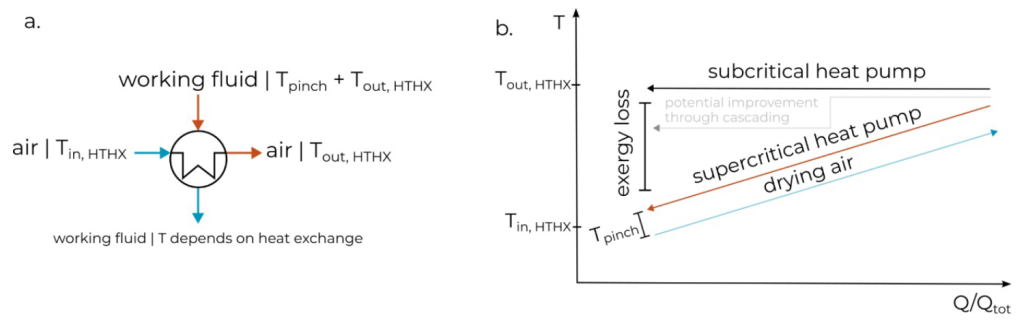
As heat (Q) is transferred to the drying air, its temperature (T) is increased. This change in temperature is called glide, and is visible as a sloping line in the T-Q diagram above. For the heat transfer to occur, there must be a small temperature difference (Tpinch) between the two fluids.
If we were running a conventional subcritical cycle, the working fluid would be changing state (condensing from gas to liquid) inside the HTHX. This process, the inverse of boiling, usually happens at a constant temperature. In other words, it has zero glide. You can see this as a straight line in the T-Q diagram. Such a heat exchange is not efficient, and decreases the COP of the heat pump significantly. Why?
Because we could always split the heat exchanger in half. A smaller heat pump, with a smaller temperature lift (and hence higher COP) could heat the air to half of its final temperature, and then another heat pump, with the original lift, could heat it up further. We can of course increase the efficiency even further by splitting that heat exchange in half, and then again, and again.
The most efficient way to run a heat pump is when the temperature of the working fluid matches the temperature of the air at all times – when it has the same glide. If this result is still not intuitive, you can find more detailed explanations in references [5] and [6]. The actual efficiency gain depends on the application, but it can be in excess of 30%.
There are two main ways to solve this problem – one is by using a zeotropic refrigerant (one which changes temperature as it boils or condenses), or by simply going transcritical, which we likely need to do anyway due to high temperatures. In a trans- or supercritical cycle the refrigerant doesn’t change state, and its temperature also changes as it flows through the high temperature heat exchanger, matching the temperature change of the air. That’s one more reason why transcritical cycles are uniquely suited to heating along large temperature glides.
Summary
Drying is a major source of CO2 emissions from industry. It is entirely possible to decarbonise all industrial dryers with heat pumps, and multiple pilot projects have demonstrated heat pumps in real-life conditions [2][7]. However, to do so efficiently and cost-effectively, we have to solve three problems:
- High temperature operation
- High temperature lift
- High temperature glide
Conventional subcritical heat pumps operate best when providing heat at temperatures below 160°C, when the heat sink has zero glide. However, many drying applications require heat at temperatures above 200°C, with very large glides. Integrating subcritical heat pumps into these processes may require major modifications, such as conversion to superheated steam, with the associated costs and downtime.
The SynchroStor advantage
The compressor-expander built by SynchroStor is a great solution for high temperature drying applications. Using our machine it is possible to decarbonise existing dyers with minimal integration work. We designed the machine from the ground up for high-temperature operation in trans- and supercritical heat pump cycles. It can:
- Operate in temperatures ranging from -100°C to 400°C
- Withstand high pressures, and efficiently operate at high pressure ratios, enabling temperature lifts of 200+°C in a single stage
- Operate efficiently in trans- and supercritical cycles with CO2, Argon, Nitrogen, or Helium as a working fluid, enabling us to heat efficiently along large temperature glides.
If you’d like to learn how our technology can help you decarbonise your drying process – reach out, visit our website, and follow us on LinkedIn.
In a future article we will explain other applications where large lifts and glides are useful – when simultaneously heating and cooling.
Stay tuned!
We hope you found this article informative and engaging. A big thank you to Marcin Morawski for his exceptional work.
Further reading
The IEA HTHP Annex 58 report, which we frequently cite in this article, has many detailed descriptions for applying heat pumps in dryers. Their conclusion is the same as ours – transcritical/Brayton cycle heat pumps are the a great fit for those applications.
DryFiciency was an EU-funded project to pilot heat pump integration in dryers for starch, bricks, and biomass waste.
Geelen Counterflow manufactures a series of dryers with integrated heat pumps, for applications up to 125°C, with an advertised COP of 2.4-3.0.
References
[1] B. Zühlsdorf et al., “Annex 58 High-Temperature Heat Pumps Task 2 – Integration Concepts,” 2024, doi: 10.23697/H7X0-TQ45.
[2] V. Wilk, F. Helminger, M. Lauermann, and A. Sporr, “High temperature heat pumps for drying – first results of operation in industrial environment,” 2020.
[3] B. Zühlsdorf, F. Bühler, R. Mancini, and S. Cignitti, “High Temperature Heat Pump Integration using Zeotropic Working Fluids for Spray Drying Facilities,” 2017.
[4] D. Holder and D. Schlehuber, “Challenges in the development of positive displacement compressors for high temperature heat pumps,” in 3rd High-Temperature Heat Pump Symposium, 29-30 March 2022, Copenhagen, Denmark, 2022, pp. 177–189
[5] H. Yan, R. Wang, S. Du, B. Hu, and Z. Xu, “Analysis and Perspective on Heat Pump for Industrial Steam Generation,” Adv Energy and Sustain Res, vol. 2, no. 5, p. 2000108, May 2021, doi: 10.1002/aesr.202000108.
[6] I. K. Shatalov, Yu. A. Antipov, and K. G. Dubentsov, “Use of the Lorenz Cycle in Heat Pumps,” Chem Petrol Eng, vol. 53, no. 11–12, pp. 716–719, Mar. 2018, doi: 10.1007/s10556-018-0410-6.