
What is a heat pump?
A heat pump is an electro-mechanical device used to transfer thermal energy between two domains. Heat pumps are commonly used in domestic and commercial applications to provide low grade heat, but also cold energy such as in air conditioners, fridges and freezers.
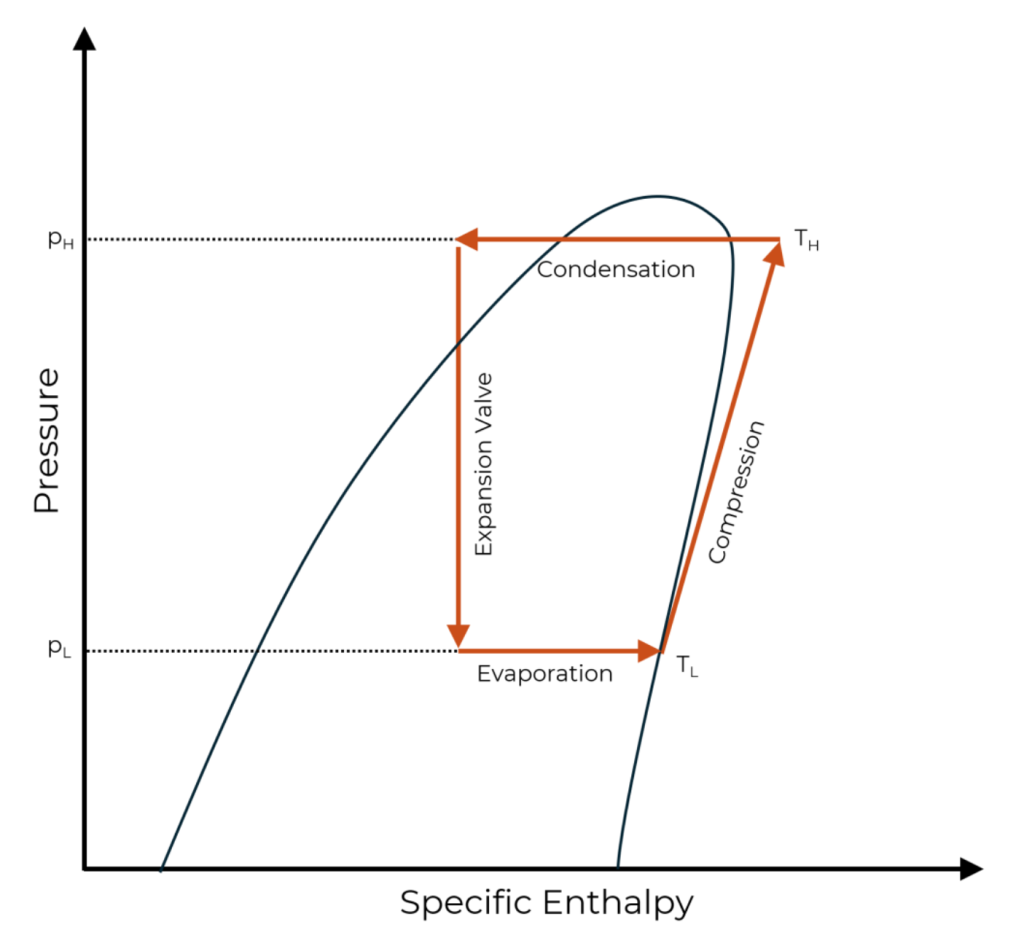
Heat pumps have a working fluid which goes through a cycle of 4 stages:
- A compression stage in the gas phase to increase the temperature of the fluid.
- A heat exchange stage at constant pressure. In this stage the working fluid condenses, transferring energy at constant temperature to the heat sink.
- A depressurization stage where the working fluid is depressurized through a throttling device, typically an expansion valve, significantly reducing the temperature through the Joule Thomson effect.
- A heat exchange stage where the cold fluid, now in a liquid phase, is sent through another heat exchanger to evaporate, absorbing energy from a heat source.
These so-called single stage “subcritical” cycles are the cheapest option and are also very efficient for sink and source applications requiring constant temperatures such as fridges and domestic heating. Operating temperatures of sub-critical cycles are limited by the maximum temperature and pressure at which standard working fluids can liquify. This limit is called critical point.
Some common working fluids (refrigerants) used in heat pumps and their critical pressure and temperature are shown in the table below.
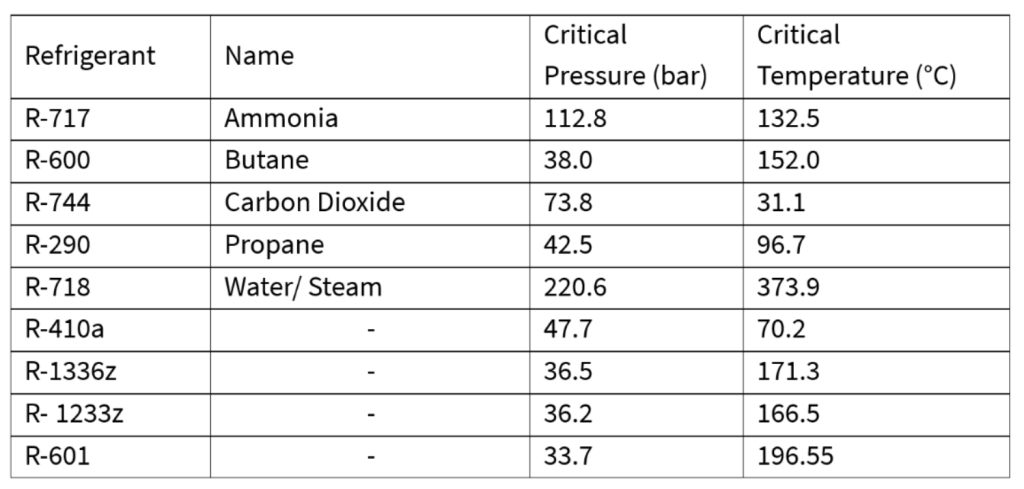
Clearly, there are very few options for subcritical heat pumps for temperatures higher than 160°C. Transcritical and supercritical cycles are part of the solution for very-high temperature heat pumps.
Subcritical cycles are not suitable for applications requiring very high temperatures, or applications where heat exchange at constant temperature is not desirable, such as drying applications. Transcritical and supercritical heat pump cycles overcome this limitation by allowing one or both heat exchange processes to take place in the gaseous or supercritical fluid phase. This allows higher temperatures and pressures to be reached. In a transcritical cycle, there is no phase change in the sink heat exchanger whereas in a supercritical cycle there is no phase change at either heat exchanger.
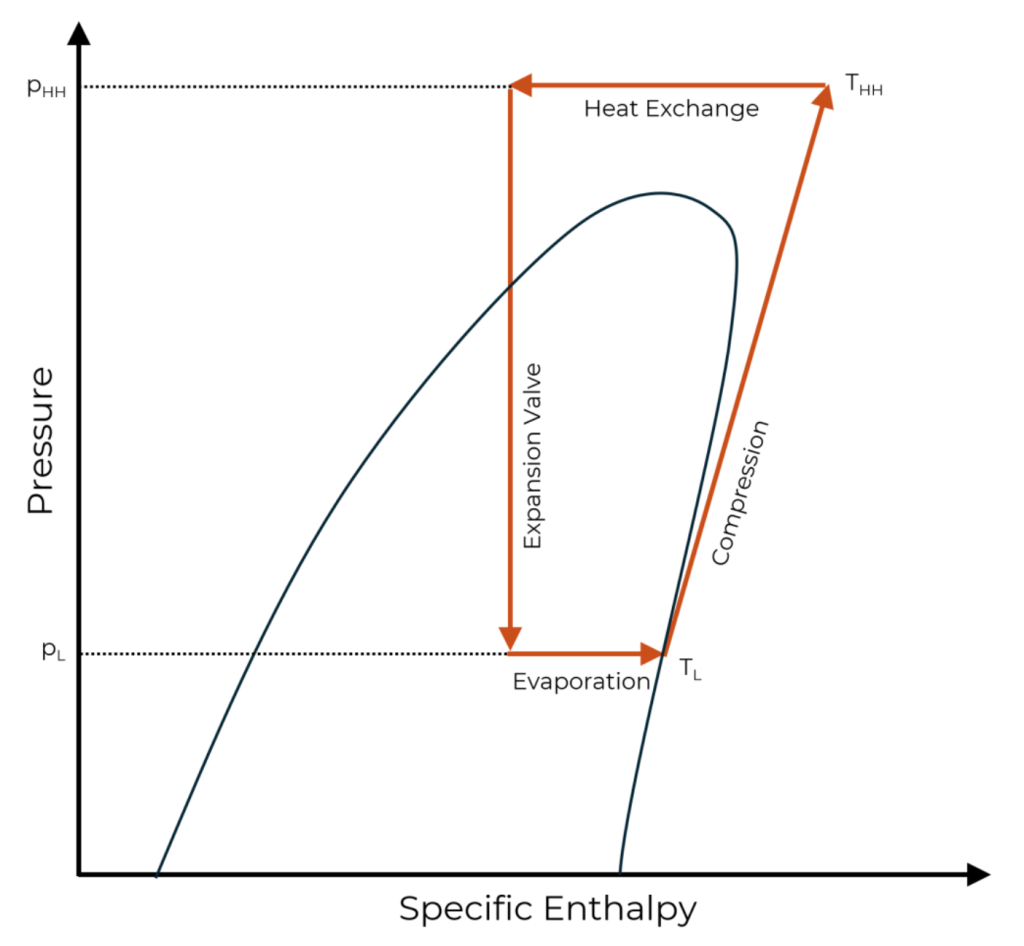
Why this doesn’t work in a high-temperature heat pump
Naturally, this comes with some obstacles. Higher pressures and no phase change generally requires more expensive heat exchangers and equipment. Furthermore, many conventional compressors are limited in their pressure ratio or the maximum temperature they can handle, requiring bespoke machines for these cycles. Finally, a cycle with a higher temperature lift is typically less efficient, requiring more work to be done by the compressor, and wasting more energy across the throttling device.
Limits on compressor pressure ratios have conventionally been overcome by using multi-stage cycles, where each machine does a smaller stage of the overall pressure lift. This is especially common for turbo-compressors. However, using multiple compressors significantly increases the cost and footprint of the heat pump and impacts efficiency.
Another disadvantage for very high temperature heat pump applications where the return temperature of the sink stays high, is the considerable energy remaining in the gas before its expansion. Throttling this gas would impact the coefficient of performance (COP) of the heat pump too much for the solution be viable. This energy can partially be recovered through an internal heat exchanger but this introduces additional costs.
How using an expander enables higher temperatures
An expander is a mechanical device that works inversely to a compressor. While a compressor increases the pressure of a gas, an expander reduces the pressure of a gas, allowing the gas to expand and, in the process, convert some of the gas’s pressure energy into mechanical work. This expansion process also results in a drop in temperature, making the expander a useful component in various thermal systems.
In theory, by replacing the throttling device in a heat pump with an expander machine, it is possible to recover large amounts of energy from the return gas stream and improve the coefficient of performance.
Let’s see how this changes our subcritical P-h diagram.

The benefit is even clearer when we consider a transcritical cycle.

Despite the benefits, there is a lack of suitable expander machines available on the market to enable such architectures at an industrial scale.
SynchroStor are developing a novel reciprocating machine that can perform both compression and expansion functions. Designed from the ground up for high operating pressures and extreme temperature lift, SynchroStor’s machine is uniquely positioned to provide best in class performance and the most cost-effective solution to enable high-COP high-temperature heat pumps to help electrify industrial heat applications.